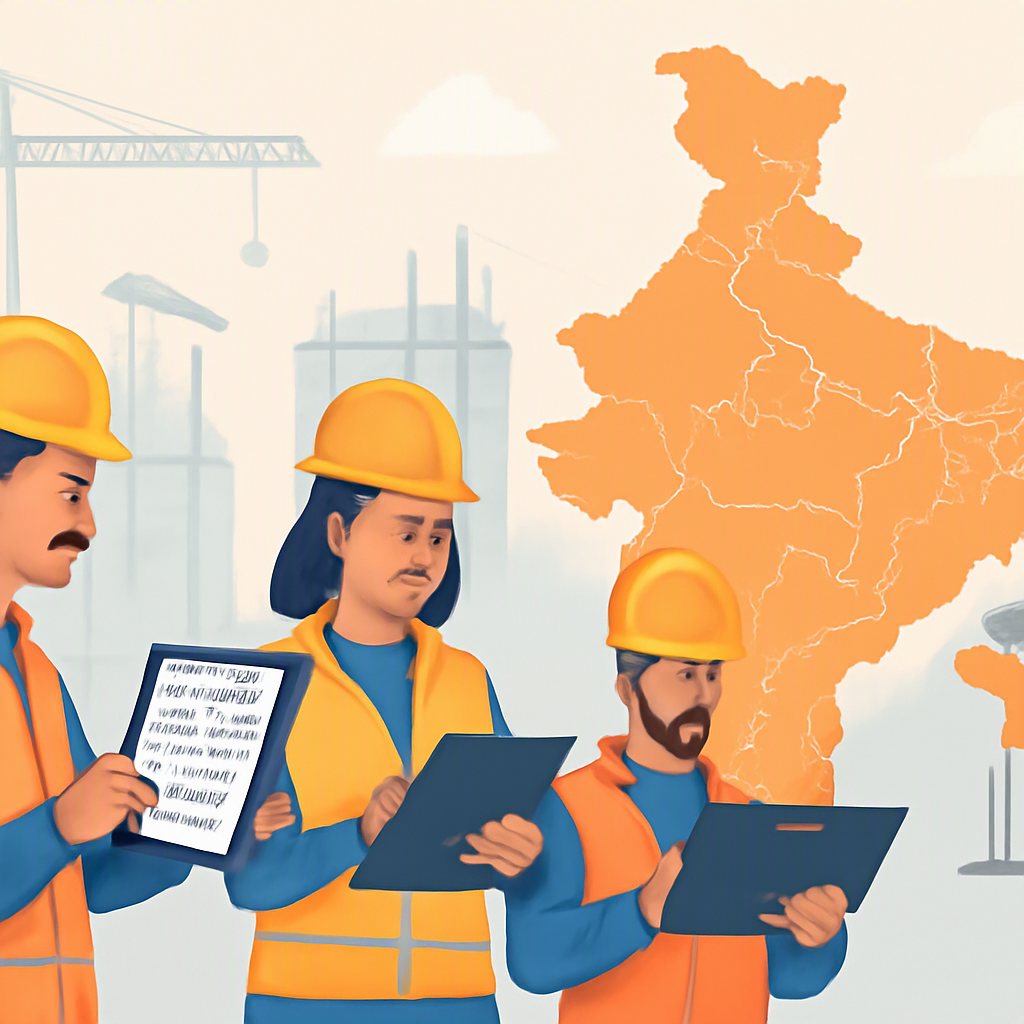
The Recruitment Nightmare: Why Bulk Hiring Fails Without Tech
If you’ve ever been responsible for hiring dozens—or even hundreds—of workers for a construction project, you already know how chaotic it can get. Finding the right people with the right skills, ensuring they’re available at the right time, and aligning them to the right site is like solving a Rubik’s cube blindfolded. And when you’re short on time, the risks multiply.
The result? You end up with delays, cost overruns, and frustrated project teams. In some cases, you might even lose the client. I’ve seen it happen—more times than I’d like to admit.
For years, we handled bulk recruitment manually. Spreadsheets, email chains, frantic phone calls to labor contractors—whatever got the job done. And it worked, sort of. But every time we scaled up, the cracks widened. Missed follow-ups, unqualified hires, and a lack of visibility into who was available for what and when. It was a mess.
That’s when we turned to technology. Specifically, AI-powered tools for recruitment and workforce management. And I’ll be honest: I was skeptical at first. But the results were hard to ignore.
What Changed: The Case for AI in Bulk Recruitment
The construction industry is notoriously late to adopt new technologies, and software doesn’t always solve the problems it promises to address. But AI is different. It’s not just a shiny new toy—it’s a practical tool that tackles the real bottlenecks in recruitment processes.
Take JobNext’s Candidate module, for instance. It integrates AI to streamline the entire recruitment pipeline, from raising requisitions to onboarding. Here's a quick breakdown of how it works, based on JobNext’s official documentation:
- Identify the Need: Project managers raise a Mobilization Request (MOB) for planned staffing or an Ad Hoc (ADH) requisition for unexpected vacancies.
- Approval Chain: MOB requests go through a structured four-level approval workflow, ensuring no unnecessary hires.
- Requisition Creation: Once approved, an open requisition is logged in the system.
- Candidate Sourcing: HR uploads candidates in bulk or manually enters them into the Candidate module.
- AI-Powered Screening: The system scores and ranks candidates based on cadre, skills, proximity to the project site, and availability.
- Shortlisting and Interviews: HR can quickly identify the best-fit candidates and schedule interviews.
- Onboarding: Accepted candidates are converted into staff records and allocated to project sites.
Why These Steps Matter
Each step addresses specific pain points in bulk recruitment. For example:
- Approval Chain: Prevents over-hiring and ensures budget alignment. This removes the chaos of having too many workers on payroll without proper allocation.
- AI-Powered Screening: Eliminates subjective bias and speeds up decision-making. The system analyzes objective factors like availability and proximity, which manual processes often overlook.
- Site-Specific Allocation: Reduces mobilization costs, a major problem for construction firms managing dispersed sites.
This is what we started using, and the difference was night and day. No more juggling spreadsheets. No more over-hiring because we couldn’t keep track of who was available. And no more last-minute scrambling to fill critical roles.
Why Manual Recruitment Practices Stick Around
Looking back, I get why we were so resistant to change. Manual recruitment has inertia. It feels manageable—especially if you’ve been doing it that way for years. There’s a level of comfort in knowing the process, even if it’s inefficient.
Common Reasons for Resistance
- Cost Concerns: Investing in AI tools for recruitment isn’t cheap. For smaller contractors, it can feel like a luxury. Hiring another HR assistant often seems like a cheaper option.
- Comfort with Familiar Processes: Manual workflows are predictable, even if they’re inefficient. People often resist adopting new systems because learning them takes time.
- Misconceptions About AI: Many assume AI will replace human jobs or that it’s too complex for their organization. These fears are often unfounded but common.
The Hidden Costs of Manual Recruitment
While manual recruitment seems cheaper upfront, it’s riddled with hidden costs:
- Delays: Slow hiring processes can stall project timelines, leading to penalties and strained client relationships.
- Turnover: Poor hiring decisions often result in higher employee turnover, driving up costs for replacement and training.
- Errors: Mismanaged spreadsheets and email communication can lead to double bookings, missed interviews, or incorrect allocations.
These inefficiencies become glaringly obvious as you scale up. Hiring 10 workers manually might be feasible, but hiring 100 or 500? That’s when the cracks start showing.
What We Do Differently Now
These days, we rely on AI for the heavy lifting. Here’s how we’ve changed our approach:
1. Automating Candidate Sourcing
Instead of spending hours manually searching for candidates, we use bulk upload features to add hundreds of candidates to the system in one go. JobNext’s Candidate module makes this easy by allowing CSV uploads and seamless database integration.
Actionable Tip:
- Prepare a clean, standardized CSV template for candidate data to avoid errors during bulk uploads.
2. Objective Screening
The AI scores candidates based on specific criteria—skills, availability, location, and more. This removes bias and speeds up the shortlisting process. No more gut-feel hiring.
Actionable Tip:
- Define clear criteria for candidate scoring. For example, prioritize proximity to the project site over secondary skills to reduce mobilization costs.
3. Real-Time Visibility
The system gives us a live view of the recruitment pipeline. We know exactly how many open requisitions we have, how many candidates are in each stage, and which roles still need to be filled.
Actionable Tip:
- Use dashboard reporting to monitor bottlenecks in your pipeline. For example, if candidates are stuck at the interview stage, it might indicate scheduling inefficiencies.
4. Site-Specific Allocation
One of the most impressive features is how the system ranks candidates based on proximity to the project site. This has saved us countless hours and minimized mobilization costs.
Actionable Tip:
- Use geo-tagging features to map candidate locations against project sites. This helps optimize travel budgets and improves worker satisfaction.
AI Isn’t Perfect—But It’s a Step Forward
Let me be clear: AI isn’t a magic wand. It won’t solve all your recruitment problems overnight, and it’s not a replacement for human judgment. There’s still a learning curve, both for the system and for the people using it.
Common Challenges
- Data Quality: The AI is only as good as the data you feed it. Outdated or incomplete candidate databases will lead to poor recommendations.
- Candidate Fit: AI might score candidates highly based on technical criteria, but cultural fit and soft skills still need to be assessed by human recruiters.
- User Adoption: Getting your HR team to trust and effectively use the system can be an uphill battle.
The Bigger Picture: AI in Recruitment Across Sectors
Construction isn’t alone in facing recruitment challenges. The tech sector, for example, has been quick to adopt AI tools for hiring. According to a 2025 report by BCG, 70% of companies experimenting with AI use it within HR. Tools like LinkedIn’s AI-powered recruiter and AI-driven applicant tracking systems are already standard in tech hiring.
Another study published in ScienceDirect highlights how AI is addressing challenges like the “Great Resignation” by identifying passive candidates and improving retention through better job-person matching. The tech industry is leveraging AI not just to hire faster but to hire smarter.
Construction can learn from this. Skilled laborers and technicians are the backbone of the industry. AI can help us identify and retain these critical workers, just as it’s doing for tech companies.
Decision Framework: Manual vs. AI Recruitment
| Criteria | Manual Recruitment | AI Recruitment |
|---|---|---|
| Cost | Low upfront, high hidden costs | Higher upfront, lower long-term costs |
| Scalability | Poor | Excellent |
| Bias Reduction | High subjective bias | Reduced bias, needs oversight |
| Efficiency | Time-intensive | Time-saving |
| Data Management | Prone to errors | Centralized and accurate |
Wrapping Up: The Cost of Being Wrong
For years, I thought AI was overhyped. I was wrong. And it cost us—time, money, and, in one case, a major project that we couldn’t staff on time.
Even now, I think about what we could be doing better. How do we ensure our data stays clean? How do we get our team to trust the AI recommendations? And how do we balance automation with the human touch that’s still so essential in recruitment?
But here’s what I know for sure: without AI, we’d still be drowning in spreadsheets and losing projects to competitors who are better organized. If you’re managing recruitment for a construction company and you’re still doing it the old way, it’s time to rethink.
If you're dealing with the chaos of bulk recruitment, JobNext can help. Get started free →
Learn more at JobNext.ai