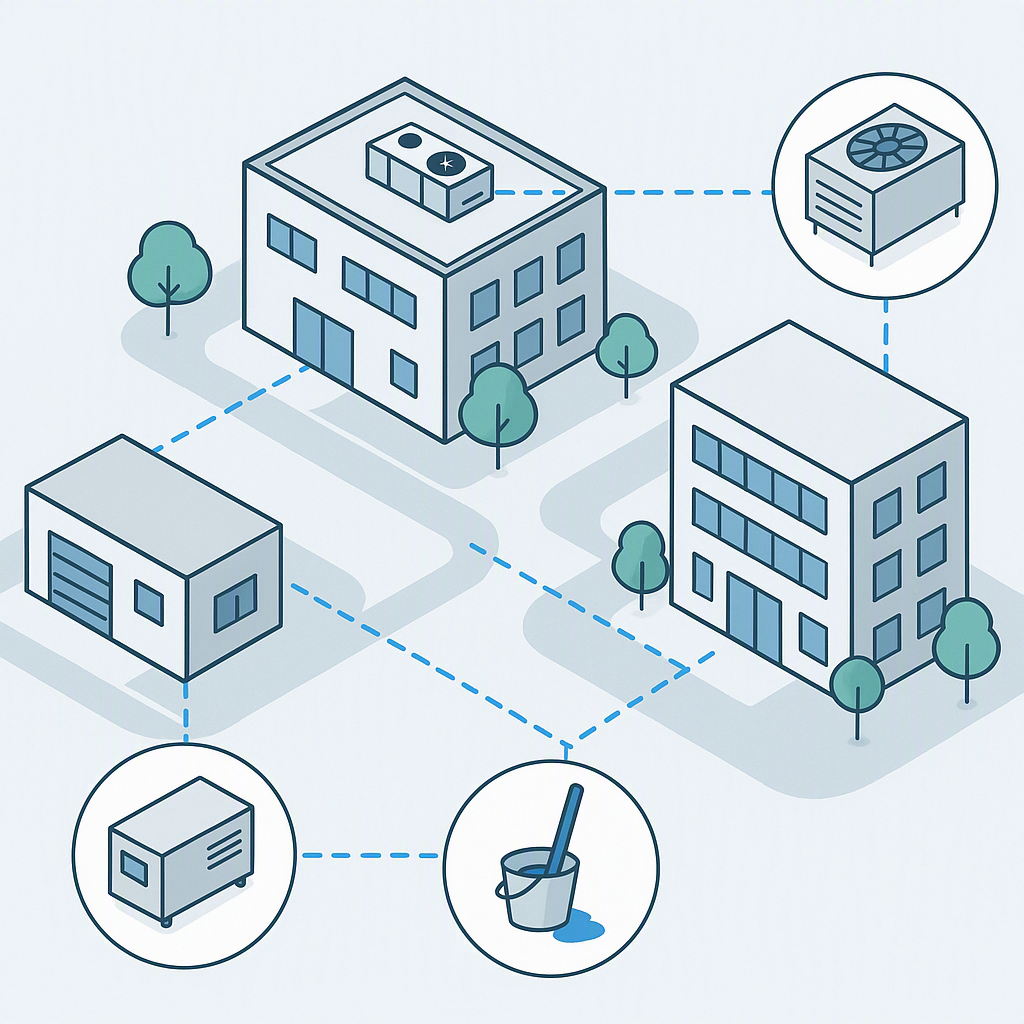
Why I Used to Think Asset Allocation Was Just a Paperwork Task
When I first started working with contractors managing facility operations, I thought asset allocation was as simple as "assign equipment to a site and move on." Hard FM (mechanical, electrical, plumbing) and soft FM (cleaning, security, landscaping) seemed to require more attention on the people managing these services rather than the tools or machines supporting them. I thought, "As long as a generator or HVAC system is working, who cares what site it’s assigned to?"
But I was wrong. And I found out the hard way.
What Changed My Mind: A Real-World Example of Mismanaged Accountability
A contractor in Oman was managing 12 facilities spread across three cities. Their operations included both hard FM—maintaining HVAC systems, electrical transformers, and plumbing—and soft FM like janitorial services and pest control.
The tipping point came when one of their high-value assets, a diesel generator, failed during a blackout at a critical facility. When they tried to identify who was responsible for its maintenance, no one could agree on its actual location, let alone who was accountable for its upkeep. The generator had been physically moved three facilities ago but was still listed in the records as "assigned" to a location it hadn’t been at for months. Worse, maintenance costs were split across unrelated sites, leading to cost disputes between project teams.
This wasn’t just a one-off headache. It spiraled into higher downtime, compliance risks, and a lot of finger-pointing. That’s when I started digging deeper into how asset allocation really works in FM operations.
Why My Original Belief Survived as Long as It Did
I’ll admit, my misunderstanding wasn’t entirely baseless. In smaller operations with fewer facilities and static assets, informal tracking often works fine. Someone knows where the equipment is. Someone else handles the maintenance. And costs? Well, they’re manageable when there’s just one or two sites.
But scale changes everything. Contractors managing hard and soft FM operations across dozens of facilities can’t rely on informal methods. When assets physically move, or when their costs need splitting across multiple jobs, informal systems fall apart. And yet, I held onto my belief because it felt like scaling up was just "more of the same." It’s not. It’s a different game entirely.
What We Do Differently Now: Clear Allocation and Custody Tracking
Here’s what I’ve learned. In hard and soft FM operations, equipment accountability depends on three pillars: direct allocation, percentage-based cost allocation, and custody tracking. Let’s break them down.
Direct Allocation: Where Is the Asset Physically?
Direct allocation answers the simplest but most critical question: Where is the equipment located? For example, if you have a diesel generator, tools like JobNext let you record its physical location as "Facility A." This becomes its operational home base. You can’t just move it without updating the system. Moving it involves a movement order process, where the asset is de-allocated from the source facility and reallocated to the destination one. The process typically includes:
- Initiating de-allocation from the source facility in the system.
- Creating a movement order specifying the destination.
- Sequential approvals: Request → Dispatch → Receive.
- Verifying the updated location in the asset profile.
Without this, assets get "lost," and no one knows where they are when something goes wrong. For instance, if a generator fails during an outage, knowing its exact location ensures faster resolution times.
Actionable Steps:
- Use software like JobNext to create movement orders for every asset transfer.
- Designate a facility manager to verify physical asset locations quarterly.
- Implement a QR code or RFID tagging system for large equipment to make tracking seamless.
Percentage Allocation: Who Pays for It?
Percentage allocation deals with cost tracking. It answers a different but equally important question: Who is responsible for this asset’s costs?
Let’s revisit our generator example. While it might physically reside at Facility A, it could also be powering Facility B. Tools like JobNext allow you to allocate the generator’s operating costs—fuel, maintenance, depreciation—across both facilities. For example:
- Facility A: 70% of costs (primary use)
- Facility B: 30% of costs (secondary use)
This percentage-based allocation eliminates disputes over cost-sharing. Every team knows exactly how much they’re paying for an asset they rely on. Compare this to informal systems where costs are "roughly split" or charged entirely to one facility, and you’ll see why structure is essential.
Actionable Steps:
- Use energy or runtime data to track asset usage at each facility.
- Update percentage allocations quarterly to reflect actual usage changes.
- Create a reporting template for facility managers to justify their cost splits.
Custody Tracking: Who’s Responsible?
One feature I’ve come to rely on heavily is custody tracking. It answers the third critical question: Who is responsible for the asset’s condition?
Custody tracking lets you assign responsibility for a specific piece of equipment to a person, team, or even a vendor over a defined period. This doesn’t affect cost distribution, but it’s invaluable for accountability. For instance:
- If a subcontractor is tasked with maintaining the generator for six months, you assign custody to them in the system.
- If an internal technician is responsible for repairs, they are listed as the custodian.
When something goes wrong—like a missed maintenance deadline—you know exactly who to follow up with. It also ensures that there’s no ambiguity when determining responsibility for asset-related issues.
Actionable Steps:
- Include custody assignment in all vendor contracts for maintenance services.
- Use software that allows time-bound custody assignments to avoid overlaps.
- Add custodians’ performance reviews to procurement evaluations.
What Happens When You Don’t Get This Right
If you don’t take asset allocation seriously, here are the typical issues you’ll encounter:
1. Cost Overruns
Imagine you’re splitting costs for a chiller used across three facilities but don’t have a structured allocation system. One facility may end up footing the entire bill, leading to budget disputes and eroded trust between teams. Over time, this can balloon into serious financial inefficiencies.
2. Downtime
In an emergency, knowing the exact location of critical assets is non-negotiable. If you don’t have accurate records, deploying equipment to where it’s needed most becomes chaotic. As in the Oman example, downtime can escalate quickly, resulting in operational and reputational damage.
3. Compliance Risks
Many assets, like fire safety systems or HVAC units, require regular maintenance to meet regulatory standards. Without clear custody tracking, these maintenance tasks can be missed, leading to costly penalties or safety hazards. In regulated industries, this can even result in legal action.
4. Vendor Disputes
If you’ve outsourced maintenance to a vendor but don’t have a clear record of their custody period, it’s nearly impossible to hold them accountable for issues. Formal custody tracking protects your organization from such disputes.
What We’re Still Figuring Out
Even with advanced systems like JobNext, there are areas we’re still working to streamline:
-
Determining Allocation Percentages: It’s not always clear how to split costs for shared assets. Should it be based on operating hours, energy consumption, or usage frequency? This requires ongoing experimentation and collaboration between teams.
-
Optimizing Custody Records: While custody tracking is great for accountability, it’s only as good as the accompanying Service Level Agreements (SLAs). Without strong SLAs, you may still face gaps in vendor accountability.
Comparison Table: Informal vs. Structured Asset Allocation
| Criteria | Informal Systems | Structured Systems (e.g., JobNext) |
|---|---|---|
| Location Tracking | Minimal or manual | Automated with movement orders |
| Cost Allocation | Rough estimates | Percentage-based, data-driven |
| Accountability | Vague | Clear (custody tracking) |
| Emergency Readiness | Unpredictable | Reliable |
| Compliance Management | Prone to gaps | Proactive (integrated reminders) |
Conclusion: The Cost of Being Wrong
Mismanaging asset accountability doesn’t just cost money—it costs trust. It creates friction between teams, delays operations, and can even lead to compliance penalties. That’s why I’ve changed how I think about asset allocation in hard and soft FM operations.
If you’re managing multi-site operations and struggling with asset accountability, tools like JobNext can help. They provide structured workflows for direct and percentage allocations, movement orders, and custody tracking—all designed to eliminate the chaos. Get started here →
For more insights into how project types influence operational failures, check out this resource: Project type ‘more than likely’ contributed to structural failure in NYC: ASCE engineer (JobNext).
Learn more at JobNext.ai