Why Tender Management Is Still a Pain Point
Tendering is the lifeblood of contracting businesses, especially in markets like India and the GCC. Winning tenders isn’t just about the lowest bid anymore. Accuracy, speed, and compliance matter just as much. Yet, most contractors still rely on disconnected tools — spreadsheets for estimating, email threads for RFQs, and standalone accounting systems for cost tracking.
The result? Mistakes, delays, and revenue leakage.
Take this scenario: A general contractor receives an enquiry from a government client. They need to prepare a detailed quote based on BOQs (Bill of Quantities), estimate resource costs, and submit the proposal within a strict deadline. Sounds straightforward. But when separate teams handle estimation, vendor procurement, and final submission without centralized coordination, errors creep in. Material costs are miscalculated. Vendor quotes arrive late. The proposal misses critical compliance requirements.
And then, they lose the tender.
The Problem With Scattered Systems
If you’re managing tenders across multiple software tools, you’re creating blind spots.
- Disconnected workflows: The handoff between preconstruction, procurement, and finance teams isn’t seamless. RFQs to vendors get stuck in email limbo.
- Manual data entry: Every time you copy project details into a new tool, you risk errors.
- Lack of real-time visibility: Decision-makers don’t have access to updated cost estimates, vendor offers, or margins during tender preparation.
Contractors running multiple concurrent projects feel this pain even more. Tendering becomes chaotic, not strategic.
A Unified Approach: JobNext’s Tender Management Workflow
This is where platforms like JobNext come in. Instead of juggling spreadsheets, procurement tools, and accounting software, what if your team could handle everything in one place?
JobNext’s tender management includes:
- 4 quoting methods (Easy, Estimate, Standard, Combined) so you can adapt to different client requirements without manual recalculations.
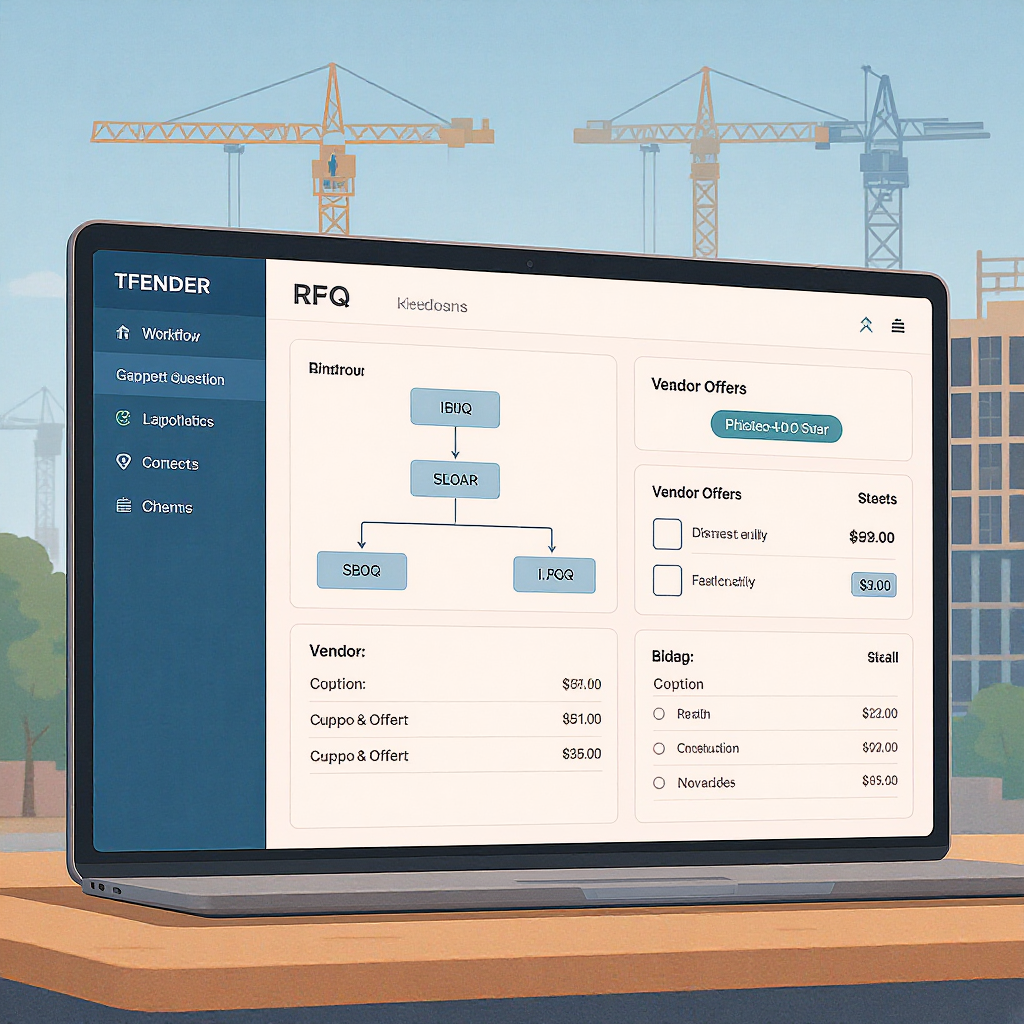
- Integrated procurement workflow: RFQs flow directly into vendor offers, which are linked to project estimates. No data duplication.
- Contract conversion: Once you win the tender, the system seamlessly transitions it into project setup with BOQ, WBS, and scope hierarchy intact.
Let’s go deeper into one example: the RFQ (Request for Quotation) → Vendor Offer → PO workflow.
Case Study: Structured RFQ Workflow in Action
A mid-sized MEP contractor in Oman faced delays in tender submissions because vendor quotes weren’t arriving on time. Their procurement team used emails to send RFQs and manually compiled responses into Excel sheets for comparison. By the time they finalized vendor offers, the estimating team had already submitted outdated costs.
After switching to JobNext, their workflow changed:
- RFQs were generated directly within the tender module, linked to the BOQ.
- Vendors submitted offers through the platform, which automatically flagged incomplete responses.
- Offers were compared side-by-side in real-time, enabling faster selection.
The result? Tender preparation time dropped by 40%. They reduced bid inaccuracies and started winning more projects — including one major government contract.
For contractors managing multi-site operations, tools like JobNext solve the visibility problem. Decision-makers can monitor tender progress, procurement activity, and cost estimates across all projects without chasing multiple teams for updates.
Don’t Forget the Compliance Factor
This isn’t just about speed. Compliance matters too. Tenders often come with strict GST/TDS rules (India) or VAT requirements (GCC). Forgetting statutory deductions can lead to penalties, or worse, disqualification.
JobNext’s integration with Tally ensures compliance from the tendering stage itself. If your finance team has ever scrambled to fix errors after submitting a bid, you know how critical this is.
Connecting Tendering to Project Execution
Winning the tender is only half the battle. The real challenge begins when you execute the awarded contract. That’s why contractors need platforms that bridge the gap between tender management and project execution.
JobNext’s tender module connects directly to project setup, ensuring all BOQ items, scope hierarchies, and resource estimates flow seamlessly into execution workflows. No manual re-entry. No lost data.
This isn’t theory. Al Nab’a Services, a 6,000-employee FM company, used JobNext’s unified platform to manage contract workflows across 1,200 sites in Oman. Their automation journey included real-time tender tracking and project setup — saving thousands of hours annually.
Key Takeaways
- Tender management failures are often caused by fragmented systems and manual workflows.
- Unified platforms like JobNext help contractors manage RFQs, vendor offers, and cost estimates in one place.
- Streamlining tender workflows reduces errors, ensures compliance, and saves time — critical for competitive markets like GCC and India.
If you’re still managing tenders across disconnected tools, you’re leaving money on the table. Isn’t it time to rethink your approach?
Further Reading
- The Hidden Cost of Tool Fragmentation: Why Contractors Need Unified Platforms
- Construction Digital Transformation: A No-Nonsense Roadmap for Mid-Size Contractors
Ready to see JobNext in action?
Multi-tenant SaaS ERP for construction, facilities management, and contracting — covering preconstruction, project execution, procurement, HR & payroll, equipment, finance, and 150+ analytics reports.
Get Started Free →Learn more at JobNext.ai