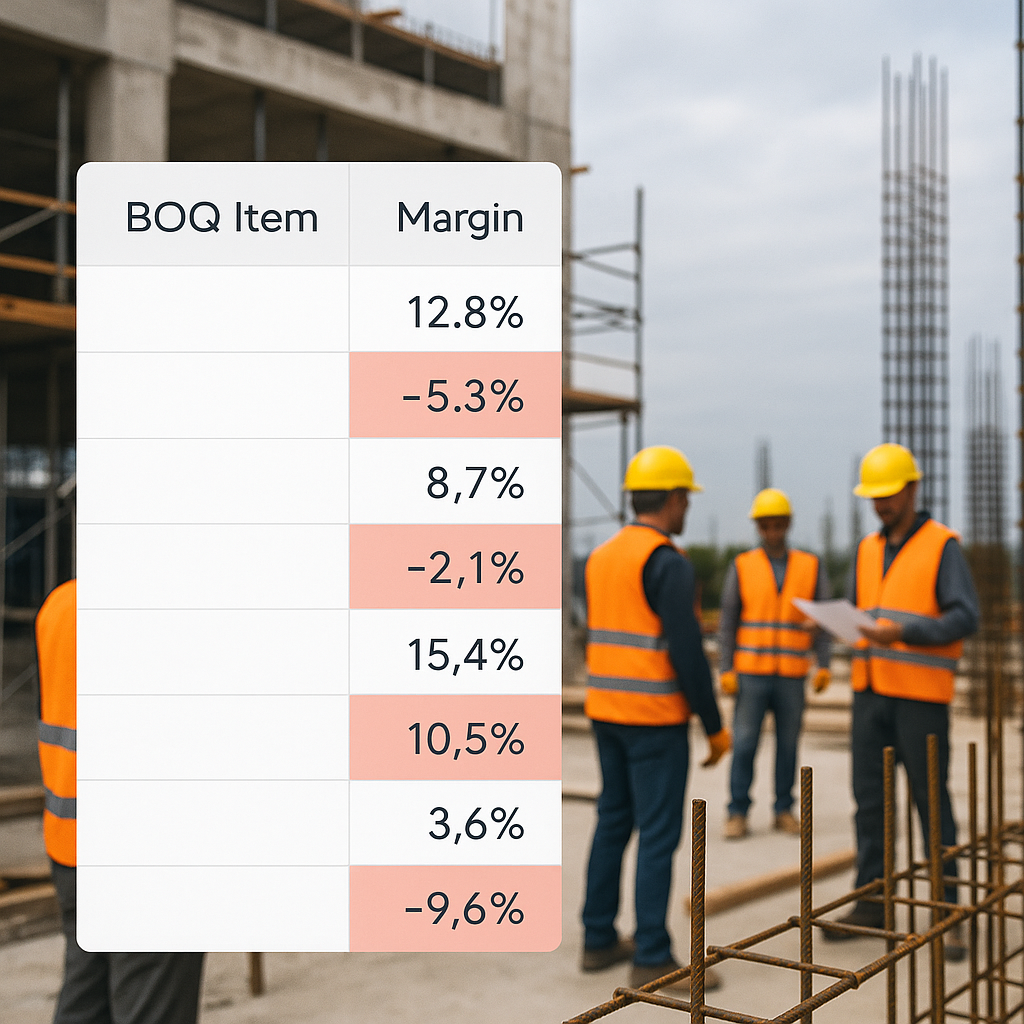
The Brutal Reality of Tight Margins in Construction
Small contractors are under siege. Material costs are unpredictable. Labour shortages keep wages high. And clients still expect competitive bids. If you're managing multiple projects, staying profitable feels like walking a tightrope.
Margins don’t vanish overnight. They erode, bit by bit—starting with a miscalculated BOQ item, a procurement overrun, or subcontractor delays. By the time you realize it, the damage is already done.
How do you fight back? The answer lies in better cost tracking, specifically through BOQ margin analysis.
What Is BOQ Margin Tracking?
BOQ (Bill of Quantities) margin tracking is a method to monitor profitability across every item in your project’s scope. It compares the contract value of each BOQ item against the actual costs incurred—materials, labour, plant, subcontractors, and overheads. This level of granular monitoring is critical for identifying areas where profitability is at risk.
Why Is BOQ Margin Tracking Critical?
Construction projects are multi-faceted, with countless moving parts. A single misstep—whether it’s an underpriced BOQ item or untracked scope creep—can cascade into significant losses. BOQ margin tracking helps contractors pinpoint exactly where they’re losing money. Benefits include:
- Improved cost visibility: You’ll know where every rupee is going.
- Early problem detection: Spot negative-margin items before they snowball.
- Informed decision-making: Allocate resources more effectively based on real-time data.
How BOQ Margin Tracking Works
BOQ margin tracking involves comparing your estimated project costs with the actual costs incurred. The process is broken down into several steps:
- Input the contract value: Record the agreed-upon value for each BOQ item.
- Track actual costs: Log all expenses related to the item, including materials, labour, and overheads.
- Analyze discrepancies: Identify items where actual costs exceed the budgeted amount.
- Take corrective action: Adjust workflows, negotiate with subcontractors, or revise procurement strategies to mitigate losses.
How Contractors Lose Margins Without Realizing It
Let’s break this down with actionable examples and methods to prevent common pitfalls:
1. Mispriced BOQ Items
The Problem:
A contractor bids ₹10 lakh for a project, assuming ₹2 lakh for steel costs. When steel prices surge to ₹2.5 lakh, the margin on those specific BOQ items turns negative. Without tracking, this loss remains hidden until the project closes.
How to Prevent It:
- Use a Price Escalation Clause: When bidding, include a clause that adjusts material costs based on market fluctuations.
- Benchmark Material Rates: Research historical data to set realistic cost expectations. Tools like price indices or procurement software can help.
- Factor in Contingencies: Add a buffer (e.g., 5–10%) to absorb unexpected price hikes.
2. Subcontractor Inefficiencies
The Problem:
You hire a subcontractor to complete plastering for ₹5 lakh. Progress tracking reveals they’ve consumed more material than planned, driving up your costs. Without reconciliation, that excess consumption eats into your profit.
How to Prevent It:
- Reconcile Regularly: Compare material usage with project progress weekly.
- Use Material Tracking Software: Tools like Tally or JobNext help track material consumption in real-time.
- Incorporate Penalty Clauses: Include clauses in contracts to hold subcontractors accountable for material inefficiencies.
3. Scope Creep
The Problem:
The client requests extra work on-site, expecting it to be covered under the original BOQ. If this isn’t documented and billed separately, you’re footing the bill—and losing profitability.
How to Prevent It:
- Enforce Change Order Policies: No additional work should begin without formal approval.
- Document Everything: Maintain a paper trail of client requests, approvals, and cost implications.
- Train Project Managers: Ensure they’re equipped to handle client negotiations and clearly communicate the need for separate billing.
How BOQ Margin Tracking Works in Practice
Here’s how effective BOQ margin tracking can save your margins:
Step 1: Weekly Margin Reviews
Use a BOQ Margin Report to analyze profitability. Focus on items showing negative margins—these are your red flags. For example, JobNext’s BOQ Margin Report highlights estimation errors, scope changes, and procurement overruns before they compound into bigger losses.
Actionable Tips:
- Assign a dedicated team member to review margin reports.
- Standardize the format of margin reports across projects.
- Use color coding to identify critical items (e.g., red for negative margins, yellow for at-risk items, green for healthy margins).
Step 2: Budget and Variance Analysis
Track budget burn rates across labour, materials, and overheads. If any resource categories consume budgets faster than planned, investigate immediately.
Actionable Tips:
- Break down costs into categories (e.g., direct materials, subcontractor costs, equipment rental).
- Set variance thresholds (e.g., 5% over budget) to trigger alerts.
- Schedule variance reviews at key project milestones (e.g., 25%, 50%, and 75% completion).
Step 3: Subcontractor Reconciliation
Before paying subcontractors, reconcile material consumption against measurements. Did the subcontractor use supplied materials efficiently? If not, recover costs from their final bill.
Actionable Tips:
- Use measurement sheets to track work completed.
- Cross-check subcontractor invoices against material usage logs.
- Conduct on-site inspections to validate reported progress.
Step 4: Real-Time Procurement Monitoring
Monitor your procurement lifecycle. Are MR (Material Requisition) approvals delayed? Are vendors delivering late? Fix bottlenecks early to avoid cost overruns.
Actionable Tips:
- Implement approval workflows for MR requests.
- Maintain a preferred vendor list with pre-negotiated rates.
- Track delivery timelines for high-risk materials (e.g., steel, cement).
Common Mistakes Contractors Make
BOQ margin tracking isn’t foolproof if you’re not careful. Here’s what we see often:
- Ignoring Weekly Reviews: Weekly margin reviews catch problems early. Monthly reviews are too late.
- Underestimating Procurement Costs: Always negotiate rate contracts for high-volume materials before projects begin.
- Skipping Subcontractor Reconciliation: Without detailed measurement sheets, inefficiencies go unnoticed.
- Overlooking Scope Changes: Document every client request. If it’s not in the BOQ, bill it separately.
Comparison Table: Common Margin Risks vs. Mitigation Tactics
| Risk | Example | Mitigation Tactic |
|---|---|---|
| Mispriced BOQ items | Steel prices increase by 25% | Add price escalation clauses in contracts. |
| Subcontractor inefficiencies | Excess material consumption | Reconcile materials weekly. |
| Scope creep | Client requests extra work | Enforce change order policies. |
| Procurement bottlenecks | Delayed material deliveries | Pre-negotiate vendor contracts. |
FAQ
1. How often should I review BOQ margins?
You should review BOQ margins weekly. Problems compound quickly in construction projects, and catching them early gives you the opportunity to act before they escalate into significant losses.
2. What tools help with BOQ tracking?
ERP systems like JobNext and Tally are popular choices. These platforms provide real-time BOQ margin reports, track material usage, and alert you to cost overruns across labour, materials, and overheads.
3. Can BOQ tracking prevent cost overruns?
While BOQ tracking won’t prevent overruns entirely, it acts as an early warning system. By identifying negative-margin items promptly, you can make adjustments before the situation worsens.
4. How do I reconcile subcontractor materials?
To reconcile subcontractor materials:
- Compare material usage against work completed.
- Use measurement sheets, photos, and on-site inspections.
- Deduct excess material consumption from their final bill.
5. What’s the average profit margin for construction projects?
Profit margins vary by project type and location. Residential projects typically see 10–20% margins, while commercial projects range from 5–15%. Focus on improving margins within your specific niche by cutting inefficiencies.
Final Thoughts
Small contractors don’t have the luxury of absorbing losses. BOQ margin tracking gives you control where it matters most—at the line item level. It’s not just about saving costs; it’s about catching problems before they scale.
If margin erosion is eating into your profits, JobNext can help. Get started free →
Learn more at JobNext.ai