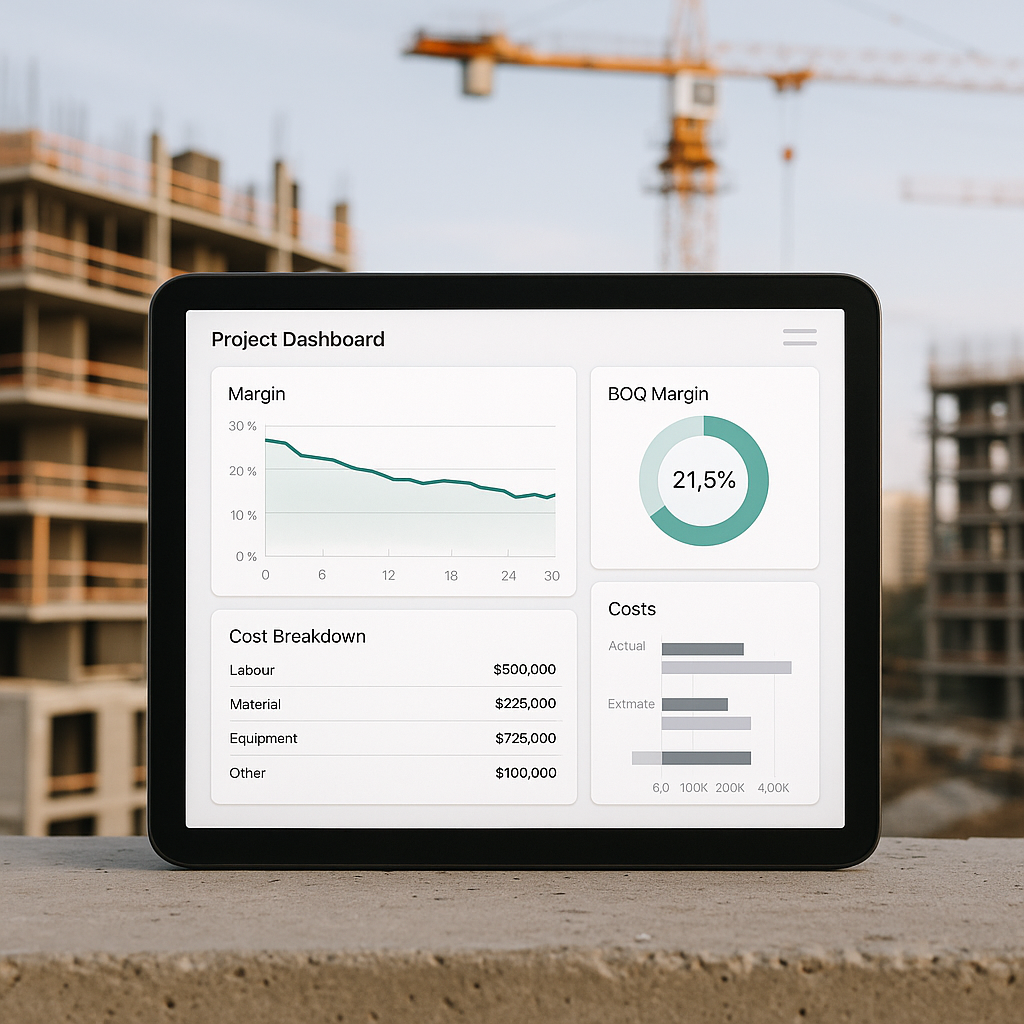
Real-Time Project Profitability: Why Contractors Struggle
Margins in construction are thin—sometimes razor-thin. A single unnoticed cost overrun in a Bill of Quantities (BOQ) item can quietly snowball into a significant loss. Many contractors find out too late.
The solution? Real-time visibility into BOQ margins. It’s not just a nice-to-have anymore—it’s a survival tool. Let’s break this down.
What is BOQ Margin Tracking?
At its core, BOQ margin tracking compares your contracted values for each BOQ item against the actual costs incurred. Specifically, it looks at:
| Metric | What it Tracks |
|---|---|
| Quoted Rate | The rate you promised your client |
| Scheduled Rate | The rate you planned internally |
| Budgeted Rate | The budget you set for procurement and execution |
| Actual Cost Rate | What you actually ended up spending on labor, materials, plant, subcontractors, etc. |
By calculating the variance between these rates, you can quickly identify which items are eroding your overall project profitability. For instance, if your actual cost rate for concrete is consistently higher than your budgeted rate, you know you’ve got a procurement or estimation problem.
One of the most critical tools for this is the BOQ Margin Report. Contractors using specialized software can run this report regularly to catch negative-margin items early. The report breaks down profitability for labor, materials, plant, subcontractors, and overhead costs, so there’s nowhere for losses to hide.
Why Most Contractors Get This Wrong
Here’s the problem: many contractors still rely on outdated methods or disconnected systems. This means:
- Delayed Updates: By the time you realize a BOQ item has gone over budget, the damage is already done.
- Fragmented Data: Labor costs are tracked in one tool, material costs in another, and so on. There’s no single source of truth.
- No Accountability: Without real-time visibility, it’s hard to pinpoint where things went wrong—was it procurement? Site execution? An estimation error?
Using a unified platform that integrates procurement, HR, and project tracking into one system can provide a clear, real-time picture of your project’s financial health.
Practical Strategies for BOQ Margin Tracking
So how do you make this work? Here are some practical steps:
1. Standardize Your BOQs
Before you can track margins, you need a consistent way to define and measure BOQ items. Use centrally managed rate schedules to ensure uniformity across projects. This prevents pricing inconsistencies and makes it easier to spot anomalies.
2. Set Up Realistic Budgets
Don’t just rely on rough estimates. Use bottom-up costing to build your budgets. Break them down into labor, material, plant, subcontractor, and overhead costs.
3. Monitor Weekly BOQ Margins
This isn’t optional. Review your BOQ margin report every week. Negative margins need immediate action. Maybe you need to renegotiate with a supplier, adjust resource allocations, or revisit your project scope.
4. Link Execution to Procurement
Your procurement team should have real-time updates on project progress and resource consumption. This ensures they’re not over-ordering or under-ordering materials. Streamlined workflows can reduce manual errors.
5. Train Your Team
Even the best tools won’t help if your team doesn’t know how to use them. Invest in training your project managers and site engineers to understand margin reports and act on them.
Illustrative Example: Catching a Negative BOQ Margin Early
Illustrative example — Imagine you’re managing a project with a BOQ that includes 500 cubic meters of concrete, quoted at a specific rate per cubic meter. By the time the first 200 cubic meters are poured, your BOQ Margin Report shows an actual cost rate higher than anticipated.
What happened? Maybe your procurement team didn’t lock in rates with the supplier, or site delays led to price increases. Either way, you now have the opportunity to course-correct before the remaining 300 cubic meters are poured.
This kind of visibility allows you to fix issues before they escalate.
Common Mistakes to Avoid
- Waiting Too Long to Review Margins: If you’re not looking at BOQ margins weekly, you’re flying blind.
- Ignoring Small Variances: Small overruns can add up significantly across large quantities.
- Blaming the Wrong Team: Use data to trace the root cause. Was it procurement, labor inefficiency, or a bad estimate?
- Not Acting Quickly: The longer you wait, the harder it is to recover lost margins.
FAQ
1. What’s the difference between BOQ Margin and overall project profitability?
BOQ Margin focuses on individual line items, while overall project profitability looks at the big picture. Think of BOQ Margin as the first layer of defense against margin erosion.
2. Can I track this without software?
Technically, yes. But doing it manually with spreadsheets is time-consuming and prone to errors. Specialized tools automate the process.
3. What if I discover a negative margin too late?
It’s not ideal, but all isn’t lost. Use the data to renegotiate with suppliers or adjust future estimates to avoid repeating the mistake.
4. How often should I review BOQ margins?
Weekly, at a minimum. Some contractors even prefer daily updates.
5. Can this help with subcontractor management?
Absolutely. By tracking subcontractor costs in real time, you can avoid overbilling and ensure they’re sticking to agreed rates.
Conclusion
Real-time BOQ margin tracking isn’t just a strategy—it’s a necessity. Contractors who fail to adopt it risk watching their profits disappear without even knowing why.
If you’re ready to take control of your margins, explore tools that can help streamline the process and provide actionable insights.
Learn more at JobNext.ai