The Silent Killer of Contractor Profits: Procurement Chaos
You’ve seen it before. A project starts smoothly, but halfway through, your team is scrambling to find materials. Vendors don’t deliver on time, RFQs are delayed, and unapproved purchases pile up. The result? ₹25 lakh in losses annually for small-to-mid contractors, according to JobsNext.ai research. And that's not counting the stress.
Why It’s Worse in India
Indian contractors face unique procurement challenges. Many rely on informal vendor relationships and manual workflows—Excel sheets, phone calls, and WhatsApp messages—to handle material requirements (MRs), requests for quotations (RFQs), and purchase orders (POs). It's chaotic, error-prone, and leads to significant inefficiencies.
Informality Breeds Chaos
Unlike in more structured global markets, procurement in India often lacks formal agreements. Many contractors rely on verbal commitments or loosely documented terms. Case in point: a Surat-based real estate contractor shared how a single missed cement delivery led to a two-week project delay and nearly ₹10 lakh in penalty payments. Why? The vendor “forgot” about their verbal agreement, and there was no written purchase order to hold them accountable.
The WhatsApp Dilemma
While WhatsApp and similar platforms have made communication easier, they’re not built for enterprise workflows. Procurement managers often juggle dozens of chats with vendors, leading to misplaced information, forgotten follow-ups, and a lack of centralized visibility. For example, a Hyderabad-based interior design firm found that 70% of their RFQs were delayed because procurement staff couldn’t locate vendor responses buried in personal WhatsApp chats.
Budget Blind Spots
Without centralized systems, it’s almost impossible to track procurement budgets in real time. A mid-sized Chennai HVAC contractor admitted that their manual process resulted in ₹18 lakh worth of unapproved purchases in a single quarter. These purchases weren’t flagged until the project margins had already eroded.
The Fix: Structured Workflows with ERP
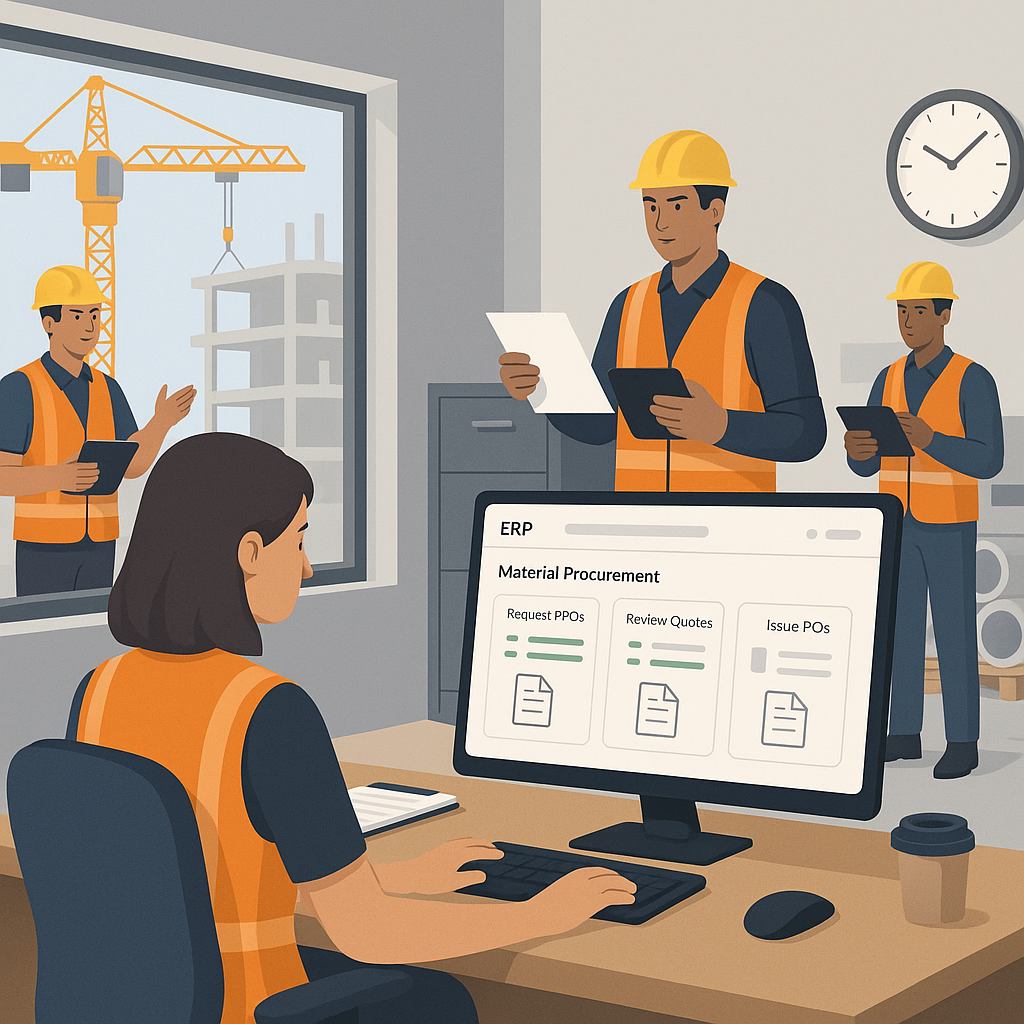
Specialized construction ERP systems like JobNext solve this with structured workflows. Let’s break it down step by step:
1. Material Requirement Planning (MRP)
Every material request starts with an MR validated against the approved project budget. This ensures:
- No unapproved spending.
- Project managers have a clear view of the material pipeline.
- Real-time updates on stock levels, preventing overstocking or shortages.
Actionable Tip: Build a habit of reviewing MRs weekly to identify trends in material usage. This helps in forecasting and negotiating better bulk rates with vendors.
2. RFQ Automation
Instead of manually reaching out to vendors, RFQs are sent to multiple vendors directly from the ERP system. The responses are recorded in one place, making it easy to:
- Compare offers side by side.
- Track vendor response times for future reliability assessments.
- Avoid losing track of quotations in email threads or WhatsApp chats.
3. Vendor Comparison and Negotiation
JobNext allows you to compare multiple vendor quotations side by side. Key metrics like price, delivery timeline, and payment terms are displayed clearly.
Real-World Example: A Mumbai-based construction firm reduced material costs by 15% after using JobNext’s vendor comparison tool. By identifying vendors with consistently lower rates, they renegotiated long-term contracts.
4. Approval Chains
Multi-level approvals ensure that every purchase is vetted. For example:
- Procurement teams check vendor quotations.
- Project managers ensure alignment with project requirements.
- Finance controllers validate against the overall budget.
This prevents impulsive or unnecessary purchases, ensuring accountability at every level.
Actionable Tip: Set up automated email or SMS notifications for pending approvals to reduce bottlenecks.
Real-World Example: An HVAC Contractor’s Turnaround
Take the example of a mid-sized HVAC contractor with 300 employees. Before ERP, their procurement team managed everything manually using Excel and phone calls. The result:
- ₹18 lakh lost to overpriced emergency purchases in a single year.
- Frequent project delays due to missed deliveries.
- Zero visibility into procurement budgets.
After switching to JobNext, their procurement process transformed:
- Savings: ₹12 lakh saved in the first six months by avoiding unapproved purchases and negotiating better vendor rates.
- Efficiency: RFQ response tracking reduced vendor follow-up times by 40%.
- Accountability: Multi-level approval chains eliminated unauthorized spending entirely.
When ERP Doesn’t Work
Let’s be honest: ERP isn’t magic. If your team isn’t trained properly, even the best system fails. Here are common pitfalls and how to avoid them:
1. Poor Implementation
A poorly planned implementation can derail your ERP project. Ensure you:
- Assign a dedicated project manager to oversee the rollout.
- Customize the system to match your workflows.
2. Lack of Training
An ERP system is only as effective as the people using it. Invest in comprehensive training sessions for your team, tailored to their specific roles.
3. Resistance to Change
Procurement teams accustomed to manual processes may resist adopting ERP. To overcome this:
- Highlight the personal benefits, like reduced workload and fewer errors.
- Start with a pilot team and showcase their success.
Why Contractors Fail ERP Training (And How to Fix It) offers additional insights on ensuring a smooth transition.
Is It Worth the Investment?
Contractors often hesitate at the upfront cost of ERP. But let’s do the math:
- Losses Due to Procurement Chaos: ₹25 lakh annually.
- ERP Implementation Cost: ₹5–10 lakh (one-time cost) plus ₹1–2 lakh/year (maintenance).
- Potential Savings: ₹12–18 lakh/year.
Long-Term ROI: In most cases, contractors recover their ERP investment within the first year—and continue to save lakhs annually.
Comparison Table: Manual Procurement vs. ERP-Driven Procurement
| Aspect | Manual Procurement | ERP-Driven Procurement |
|---|---|---|
| Material Requests | Informal, error-prone | Automated, validated against budget |
| RFQ Process | Manual, time-consuming | Automated, centralized |
| Vendor Comparison | Subjective, scattered data | Objective, side-by-side comparisons |
| Approval Chains | Often skipped | Multi-level, enforced via system |
| Budget Tracking | Reactive (post-spend analysis) | Proactive (real-time tracking) |
| Overall Efficiency | Low | High |
FAQ
Q: What’s the biggest mistake contractors make with ERP?
A: Assuming it’s a plug-and-play solution. ERP needs proper setup, training, and adoption to work effectively. Skipping these steps leads to poor ROI.
Q: Can ERP work for small contractors?
A: Absolutely. Systems like JobNext are designed for contractors with as few as 50 employees. Smaller teams often see faster ROI because they can eliminate inefficiencies more quickly.
Q: How does JobNext handle multi-site operations?
A: JobNext centralizes attendance, payroll, and procurement workflows across multiple project locations. This gives you a unified view of your operations, even if you’re managing 10+ sites simultaneously.
Q: What’s the average implementation timeline for JobNext?
A: The average implementation takes 4–6 weeks, including training sessions. However, timelines can vary depending on the complexity of your workflows.
Q: Are vendors resistant to RFQ automation?
A: Most vendors appreciate the efficiency of automated RFQs, as it reduces manual follow-ups and provides clear timelines. Early communication and training can help onboard reluctant vendors.
Call to Action
If you’re losing money to procurement chaos, JobNext can help. Get started free →
Learn more at JobNext.ai